

Who Actually Licenses BCPoker
The platform is run by TwoCent Technology Limited, a company registered in Belize under Company No. 000041939. Its gaming license comes from the Anjouan Gaming Authority (Finance Authority of the State of Anjouan, Union of Comoros), License No. ALSI-202410011-FI1. That license is what puts BCPoker under formal regulatory oversight in the first place, and every compliance process described here traces back to the obligations attached to it.
How BCPoker Handles Anti-Money Laundering
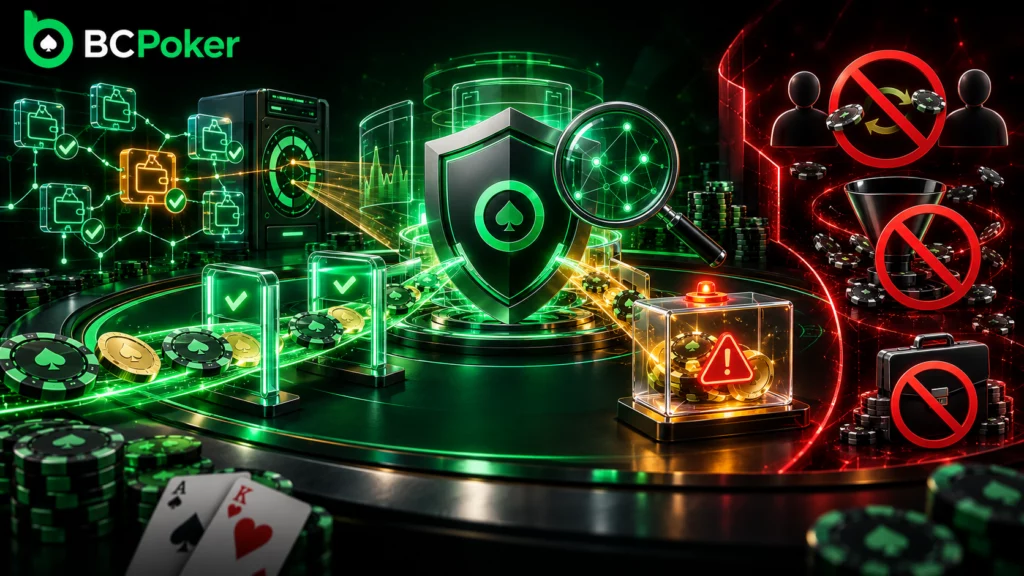
There’s a fairly standard AML setup behind the scenes: transactions get monitored in real time, and anything that looks off, an oversized deposit, a strange pattern, a mismatch between account history and activity, gets flagged automatically. Once a flag hits a certain threshold, Enhanced Due Diligence (EDD) kicks in, which can mean a temporary hold on the account while things get sorted out. Wallet addresses go through sanctions screening via third-party blockchain analytics tools as well, so funds tied to known bad actors don’t slip through unnoticed. Two things are flatly banned regardless of circumstance: peer-to-peer transfers between BCPoker accounts, and the use of mixers, tumblers, or corporate accounts, since all three are common tricks for hiding where money actually came from.
KYC: Why It Matters More Than It Looks
Verification isn’t optional forever, even if BCPoker lets you play before completing it. Before a first withdrawal, before certain bonuses unlock, or the moment an account triggers a large-transaction or unusual-activity flag, KYC becomes mandatory. It’s not a heavy lift on paper, a government ID or passport plus some basic details, and approval usually lands within a few hours on business days. But that paper trail matters: it’s what gives BCPoker something concrete to point to if a legitimate legal inquiry ever comes up, rather than an anonymous account with no history behind it.
The Security Layer Behind the Scenes
BC Shield wasn’t built specifically for law enforcement purposes, but it ends up doing a lot of that work indirectly. It runs AI-driven behavior detection to catch bots, uses facial liveness checks to confirm a real person is sitting at the table, and blocks emulators, virtual machines, and remote-access tools like TeamViewer or AnyDesk that people sometimes use to run accounts they shouldn’t be running. The less room there is for someone to fake their identity or hijack an account, the cleaner and more reliable the underlying records stay if they’re ever needed. On top of that sit the more conventional protections: AES-256 SSL/TLS encryption, optional Google Authenticator 2FA, and lockouts after repeated failed logins.
Countries BCPoker Won’t Serve
Some jurisdictions are off-limits outright: the United States, United Kingdom, Netherlands, France, Spain, Austria, Germany, Australia, Comoros, and anywhere on the FATF blacklist. It doesn’t matter how a player deposits or what their account history looks like, access from those regions isn’t permitted, and accounts detected there can be reviewed or suspended under the terms of the platform’s license.
Where Player Funds Actually Sit
Money held at BCPoker doesn’t mix with the company’s operating funds. Balances sit in segregated wallets backed one to one, and that setup gets checked through independent public audits. It’s a fairly simple structure, but it means there’s a clear, verifiable record of what’s held and where, which matters both to players and to anyone reviewing the platform’s finances.